
Day 13, October 9, 2026 Seeing Old and New Seoul
Today we met our guide in the lobby at 9:07 am. We were delayed due to a problem with sewer odor coming up from our toilet and smelling up the entire bathroom and our bedroom. The odor was atrocious! We called the management office, and a very polite young man was dispatched quickly to address the problem. Apparently, it occurs so often that he knew what to bring and how to fix the problem. It worked and we were delayed only 7 minutes for our tour.
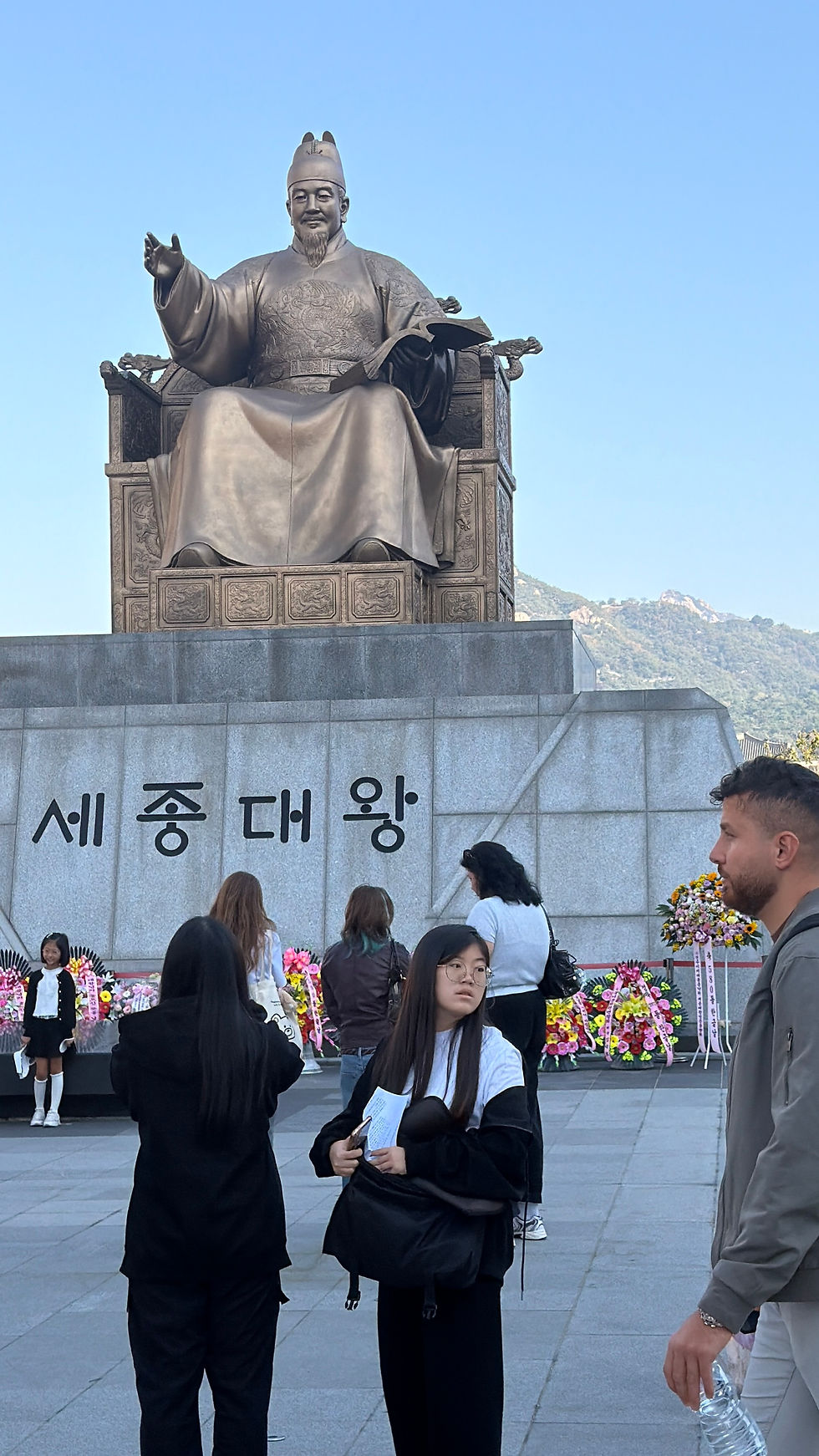
Today is a national holiday and a lot of people are on the roads and about in the streets. The holiday is called Hangeul Day, and it celebrates King Sejong the Great, who created the modern Korean alphabet called the Hangeul in 1446. King Sejong the Great was the fourth monarch of the Joseon Dynasty, and he is widely regarded as one of the most influential and revered rulers in Korean history. There is a stature to honor him in Gwanghwamun Square. Locals and people from around the world joined the celebration. Many of them dressed in old traditional Korean clothing. All around the city, they looked colorful in their various outfits.
Our first stop was the imperial place, the Gyeongbokgung Palace, to witness the ceremonial changing of the palace guards (think England’s changing of the guards). This ceremony takes place twice a day, and we were there for the 10:00 am ceremony. Doug videoed the entire ceremony, but here are many still photos, to show how the ceremony unfolded in the palace courtyard.
After the ceremony was concluded, we toured the palace grounds within the first, second and third gates. We also saw the Banquet Hall that was able to accommodate over 1000 for a party back in the 15th century. The Banquet Hall is surrounded by a moat.
We proceeded through the palace grounds towards the West Gate and exited to meet our driver. From the Gyeongbokgung Palace, we went to the National Folk Museum of Korea. After entering, Patrise sat in the cafe, while Grace and Doug went through it. We only walked through the Section 3 permanent exhibits: Korean Life Passages, explaining the folklore and beliefs surrounding the various stages of life, from birth, to coming of age, to growing old, then dying. It was a fascinating story, and I wished we had more time for it. Here are some of the photos of exhibits and explanatory plaques.
From the National Museum, we drove to an old section of town, the Bukchon Hanok Village, where numerous Koren-styled hanoks were built over 600 years ago in a manner that looks like a huge planned community. During the time of the Japanese occupation of Korea, the Japanese had planned to tear down the Korean houses and put Japanese-styled housing instead. However, an architect and developer, Jeong Sekwon, owned the land. He managed to preserve the housing by allowing poor and middle class koreans to move into them, taking our 30-yr mortgages that he personally financed. As such, he preserved the housing and he is revered as a national hero in South Korea. Now, these houses are part of a national historict district, they are very, very expensive to live in -- costing in the range of $2million to $10million -- and they cannot be modified without first gaining permission from the national government. We were told that this was the area where several K Dramas were filmed. Hundreds of young tourists were engaged with taking selfies in the area in front of several residences. Here are many photos from our walk through the district....
After visiting the village, we had lunch in a traditional Korean restaurant in the area. We finally experienced bulgogi, along with numerous other side dishes like fried anchovies, kimchi, plum tea, sauteed green herbs, rice, and salad.
After lunch, we decided to head to a traditional shopping area to look for some oolong tea; then we returned to the hotel. Patrise went to get a foot and body massage, and I went to take a nap. When Patrise returned, we went to look at a part across the street from our hotel. Hullyeonwon Park used to be a military training ground during the Joseon era of Korea history. The statue in the park is dedicated to General Yun Kwan, who revolutionized Korea's army.
Here are some photos of the streets and crowds in and around Seoul today....
We decided to just order dinner in the room and relax for the rest of the evening. We are both looking forward to a trip to the Demilitarized Zone tomorrow morning.


Comments