
Day 16, October 10, 2026 The DMZ
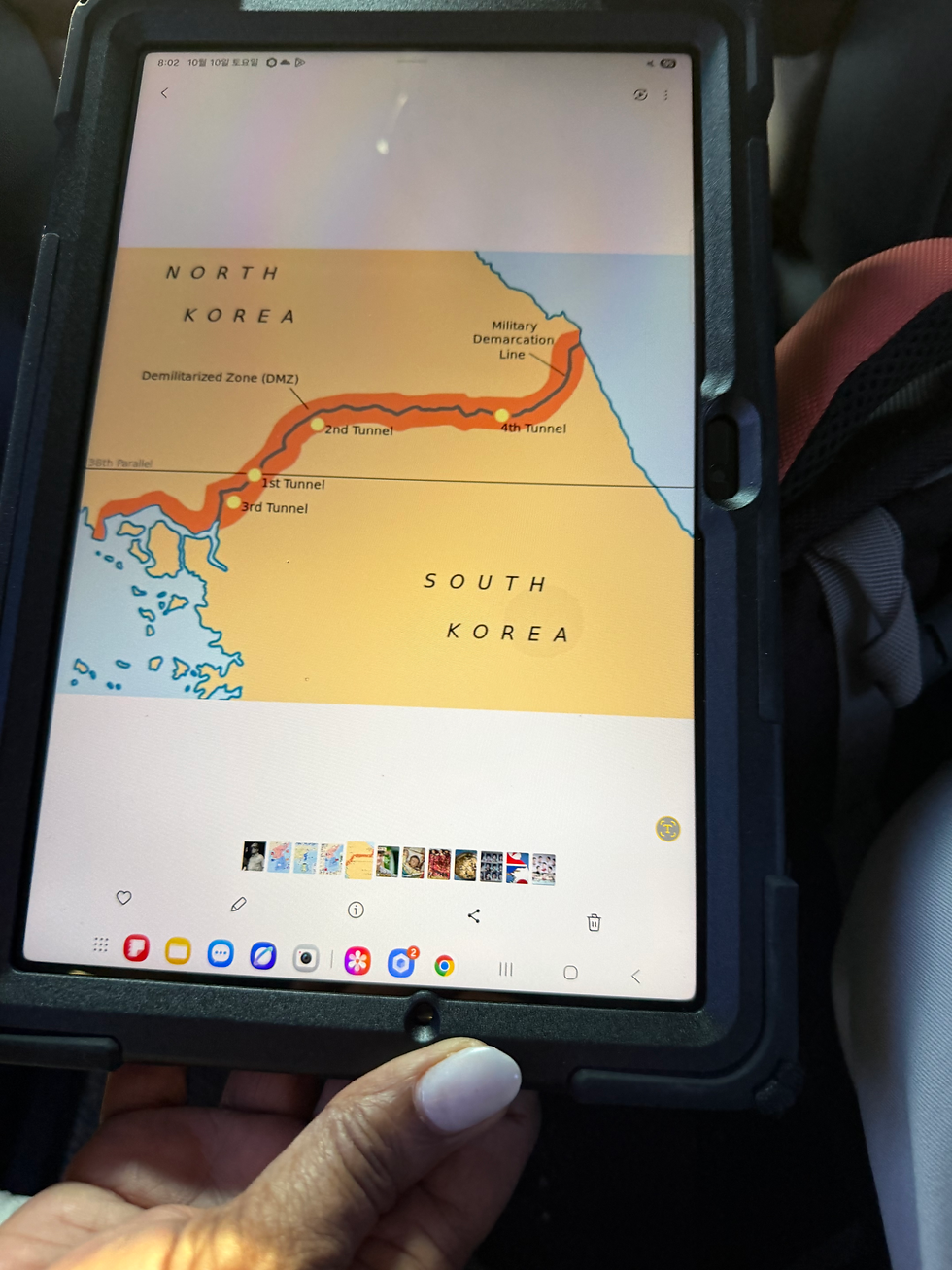
Today we met our guide in the lobby early to head for the Demilitarization Zone (DMZ) between North and South Korea. This area is about 1.5 hours north of Seoul and we are trying to get the early shuttle into the area. What we learned was very complicated, but here is a synopsis of the experience.
The DMZ was created by an agreement between China, North Korea and the United States. South Korea never signed the Armistice Agreement. It was designed to put an end to the Korean War, but South Korea was opposed to the separation of the country, so they refused to sign it.
Before the Korean War/Conflict – the United States has never officially “declared it a war” – for several decades Korea had been a colony of Japan, until the end of WWII. Through many centuries, Japan and Korea had often fought wars. After WWII, as communist China and the Soviet Union supported the original North Korean dictator (Kim Il Sung), and as the United States embraced the South Korean military leadership, it was apparent that North and South were beginning to diverge politically and economically. Then, three years after the Korean War ended, North Korea invaded South Korea, thereby violating the terms of the Armistice agreement. South Korea had not trusted that North Korea would adhere to the terms of the Armistice Agreement, and they were correct.
The DMZ is a 2km-wide zone, a “border” enforced by barbed wire fences and military forces stationed on both sides of the zone. The South side has a line of blue bollards (yep, like the ones that prevent access to a parking lot or driveway) and the North has a line of white bollards. The blue bollards and line are formally called the Southern Limit Line, while the white bollards and line are known as the Northern Limit Line. In between, there is the MDL, the Military Defense Line. (Also in the middle is the JSA, the Joint Security Area staffed by South Korean and American soldiers. It used to be open to visits from tourists, but has not been for some time now.) The bollards are designed to delineate the area into which either side is prohibited from entering. Demilitarization is a misnomer, because there are troops from each country everywhere! However, magically, the combat forces are precluded from engaging in any military action within the designated zone. We have attached a pictures of the area for you to see what we are talking about.
Row 1: Signs and barricades at the SK (South Korea) checkpoint to approach the DMZ.
Row 2: Commercial and private vehicles being cleared through the SK checkpoint.
Row 3: The "Gateway to Unification (in South Korea), SK military vehicle, the "blue line" denoting the SLL. The SLL is the southern limit of the DMZ.
Row 4: Photo inside the DMZ, entering the DMZ visitors center, a model of the JSA.
There are small towns inside the DMZ. There are two "propoganda villages", one with 150 residents, and another with abotu 400 residents. The Unification Village is called Tongilchon, and the other is Paju City. Paju City os the South Korean city nearest to the North Korean border.
The odd thing is there is no difference geographically between North and South Korea. Ordinary people are farming on both sides of the DMZ, and hills and mountains are visible in the distance. There is a river that runs between the two areas, but the river is not the boundary line.
In order to access the DMZ, we had to get on a specially permitted tour bus and drive to a check-in point where everyone’s passport or identification was inspected by a military soldier with his rifle in tow. It would be a little scary and intimidating for someone who had something to hide. I think that this show of force is designed to intimidate and therefore deter people from entering the zone, because once in the zone, it would be easy for anyone to defect to the other side. This is less of a problem for South Korea because the defections are primarily from the North to the South.
The trip inside the zone was about an hour. There is access to one of the four tunnels into South Korea that were dug by the North Koreans after the DMZ was created. Those sneaky North Koreans had devised a system of tunnels which would allow them to send 30,000 troops in an hour directly into Seoul. An engineer who defected to South Korea informed the South Korean government about the tunnels, othe wise the tunnels are so deep that South Korean had no idea what was going on. North Korea is a poor country and its people are hungry. Desperate people/governments do desperate things. The two Koreas are truly opposite from one another. North Korea is not well developed, does not have access to reliable electricity and they deny access to any information from the outside world that is not sanctioned and authorized by its government. South Korea is financially strong with plenty of development and investment. It allows for open and free speech and is democratic in its operations. North Koreans are kept in the dark, so that they do not know about the better life that exists within the south. North Koreans are also subjected to propagandistic training from the age of 3, which focuses on how great North Korea and its “Great Leader” are versus how people are “mistreated” in South Korea and how “poor” is South Korea. It’s a sad state of affairs. The people in South Korea desire a reunification of the entire country and many of them remain optimistic that it will happen one day.
By the way, there were thousands of visitors there, from South Korea and from so many other nations around the world. Clearly, there is a large degree of fascination with these two countries (South and North Korea) and the area of constant tension(the DMZ), which divides them. Here are some of the many pictures Doug took of our visit inside of the DMZ. The one area were not allowed to take photos of any sort (with teo small exceptions) was the observatory area, where there are dozens of mounted periscopes that enable a visitor to see North Korea in the distance: farms and fields, towns and buildings, and even people!
Row 4: photo 2 and 3 are about a former North Korean soldier who defected. He was on patrol with his army unit, had been drinking excessively, jumped in a jeep and fled toward the DMZ. Had to leave his jeep and continue fleeing on foot. He was shot five times and fell down just short of the DMZ line. South Korean soldiers crawled to where his body was and pulled him into the DMZ area, while being fired upon. The doctor who operated on him (photo 2) declared that he had many parasites/worms in him, which are displayed on a screen behind the doctor. The soldier (photo 3) recovered. In his drunken state, he had left behind his parents, a wife and daughter. It was reported that the parents had to serve in a detention camp and reeducation center for years.
Row 1: On a map in the ground, Doug enacts fleeing North Korea (left), crossing the DMZ (center), the safely reaching South Korea (right).
Row 2: The entrance to the information center, visitors, and access to the Third Tunnel.
Row 3: A map of the Korean freight rail system; a model of entrance of the interceptor tunnel to the Third Tunnel; a model of how North Koreans dug by hand and planted dynamite to establish the tunnels. This was told by a North Korean defector who was a tunnel engineer.
After spending the entire morning in the DMZ, we returned to Seoul after visiting the DMZ observation deck. We ate lunch at the site where we caught the bus into the DMZ and headed back to Seoul. We both dozed off on the return trip.
When we got back to our hotel, Patrise was determined to relax, and I started on the summary of my thoughts and ideas about the trip. Patrise located a well-reviewed restaurant for dinner, which was located in a more trendy section of town that is frequented by young adults. We enjoyed a delicious dinner at Refine Myeongdong Euljiro-jeam. I had a spicy pasta noodle dish with pork belly and Patrise had a shaved beef dinner with vegetables and a clam soup. The clam soup was stellar! We shared both meals and had a really great evening.
We decided to take an Uber back to the hotel and that required us to walk to a nearby main street. On our walk to that street, Patrise discovered a bakery that she wanted to try, and we went in to find some tasty treats to close out the day.
We ended our last full day in Seoul feeling wonderful and thinking about our experiences. We head home tomorrow.


Comments