
Day 8, October 2, Kyoto => Kiyomizu
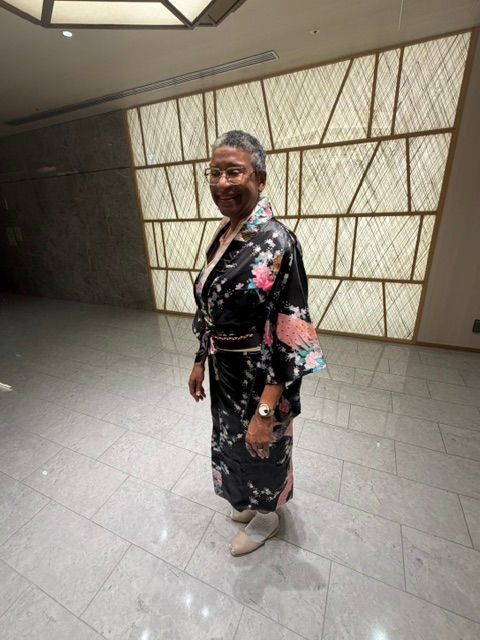
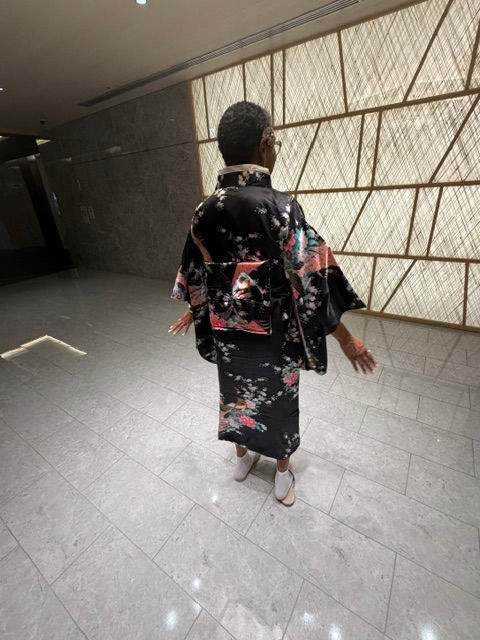
After doing Wordle, taking showers, and getting dressed for the day, we headed to breakfast. We sat near Genghis Shakhan and spoke with him, as we were eating. (I don’t how I am going to reset my expectations to have breakfast without pork dumplings. Love those snack size morsels in the morning!) As we gathered to load the buses, many of out companions were awestruck by Patrise’s outfit. She dressed in a traditional Japanese kimono and decorative headpiece, which I had bought her for a Christmas present last year. I had also purchased her books on (1) learning Japanese language, (2) Japanese food culture and tradition, and (3) a Travel Japan guide – all as Christmas presents, to help prepare her for this journey.
Along the way to the temple and shrine, Joyce filled us in on several facts about Kyoto...
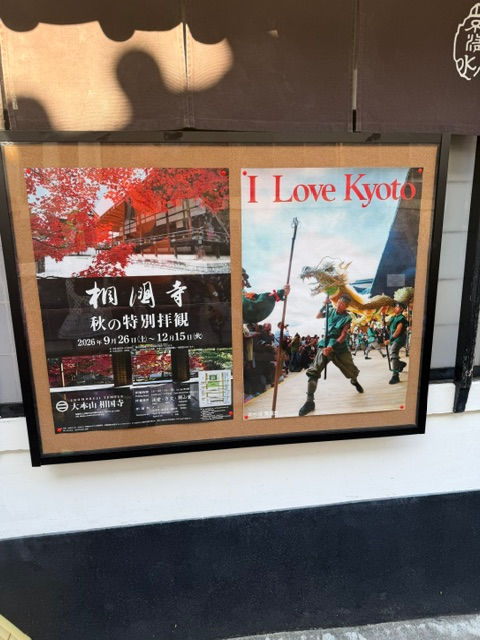
Ø Kyoto is Japan’s 7th most populous city with a population of 1.5 million, metro
population of 3.4 million.
Ø Kyoto is one of the most visited cities in the world, having 20-30 million visitors per year.
Ø The city and metro have almost 2,000 shrines and temples.
Ø Kyoto City has 17 UNESCO World Heritage sites – 17! That is an astounding number for one city in the world.
Ø Kyoto is the cultural capital of Japan. For many years, until 1869, it was the country’s capital and the seat of the government. Once Emperor Meiji permanently terminated the Shogunate and began modernizing the country, the country’s governmental capital was moved to Edo (which became “To-kyo” literally “east capital”).
Ø There is a building height limit in Kyoto, to maintain much of its ancient character. Yes, there are a lot of modern buildings, but few that we would consider “skyscrapers.”
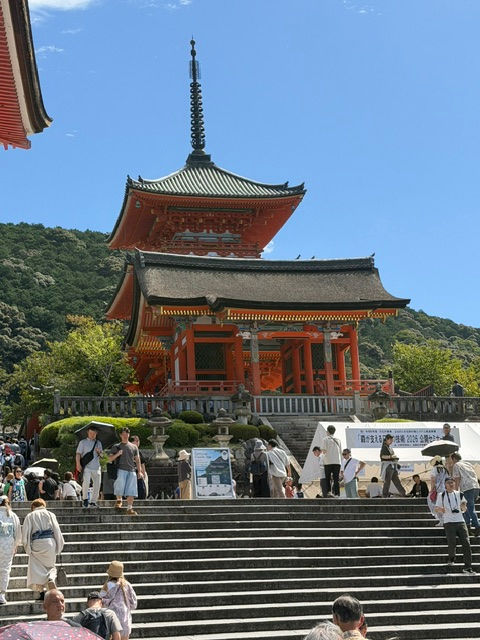
As we toured the Kiyomizu-dera heritage area, it was very easy to believe the city gets 20-30 million visitors each year – many of them Japanese themselves. There seemed to be endless streams of school children visiting, many of whom were distinguished by their uniforms. There are many tour groups with Japanese senior citizens, teens and college age young adults. Then there were many tourists from around the world: Indians, Australians, Malaysians and Indonesians, countries of Spanish-speaking origins, visitors from Arabic-language nations, a smattering of Scandinavians and Eastern Europeans, to judge by the sounds of their languages and paraphernalia. And Americans, of course.
Visitors from all around the world seeing Kiyomizu-dera Temple compound
When we arrived at the temple compound, Joyce designated the first twenty of us on the bus to be the initially group to attend the tea ceremony. While we were heading to learn about and experience this time-honored Japanese ritual, the rest of our bus mates and the balance of the other busload would go with Barbra – the other tour guide – to the Temple itself. Later, the groups would switch, but the guides would remain the same for each site. In essence, Joyce and Barbra switched groups to lead, but they stayed with the same part of the tour throughout the morning: Joyce was all things tea ceremony, which Barbra was all things temple and shrine.
We arrived at the spot for the tea ceremony, having descended a considerable length of stone stairs. Then, we waited outside of the shop, as the staff was still making preparations for our ceremony. After a ten-minute delay, we were invited to come into the store, take off our shoes, ascend a short set of steps and enter the room. Some of us were able to sit (on very low, very small) chairs, while others were asked to sit or kneel on the floor. After brief introductions, our hostess explained to us the origins of the team ceremony, its significance in the history and culture of Japan, and what it is intended to invoke when people participate in it. She described the basic elements, and then she informed us that a “normal” ceremony is performed without speaking.
She left the room, then returned and silently began performing the tea ceremony. I won’t try to describe all of the steps: one, I cannot remember all of them and two, I would take up a lot of space in this blog entry, describing all of those I do remember. I will just present a series of photos, showing the order of the steps she took. Once she finished preparing the matcha tea, she then began speaking to us once more, telling us how we should prepare the tea and how the tea is consumed and the two items consumed with the tea. First, there is a round rice cookie; second, there is a hard sweet derived from sugar cane. The cookie is eaten first. Once it is, then the sweet is eaten. Only after these are completed is the tea drunk. The idea being that the unsweetened tea will be enhanced by the sweetness left in the mouth by the cookie and the sweet treat.
What follows is a succession of photos depicting the steps of the tea ceremony, followed by photos of us undertaking various parts of the tea ceermony...
We finished the tea ceremony. By the reactions, clearly, we all enjoyed witnessing and participating in this timeless tradition. We went downstairs, gathered our shoes, browsed through the shop then went outside for the big switch. It was explained to us the tea ceremony first group would now follow Barbra to go to the temple and the shrine, while the temple team would now follow Joyce to the next setting of the tea ceremony. As we were going back up the steps we had descended earlier, Patrise decided not to go further. She was feeling heat exhaustion coming on, so she sat to recover while I continued to the group.
The walk to the temple was up a steep incline among hundreds of people, some headed in the same direction, others streaming towards us. It made of a lot weaving in and out of crowds, while keeping an eye on Barbra’s whereabouts with her tour guide flag. She did a great job of stopping occasionally, in order to be sure she kept the group together. We eventually arrived at the temple and shrine. The temple is known as the Kiyomizu-derah and the nearby, major shrine – there were others on the compound as well – is the Jishu Shrine.
Barbra explained the differences between temples and shrines, in general, and the reasons for the Kiyomizu temple and the Jishu Shrine. She also explained the differences between Buddhism and Shintoism. Buddhism is the veneration of The Buddha considered a great, enlightened man. Buddhism came to Japan thousands of years ago, traveling from the country of it origin, India, to China, to the Koreas and other southeast nations, and finally arriving in Japan in the 6th century A.D. Shintoism is a religious practice based on the belief in and worship of many gods. It is an indigenous religion, in which over 8 million gods are acknowledged and offered some form of reverence and veneration – although not at the same time mind you. The gods of the tree, the stream, the fields, the birds, the home, the fireplace, etc., etc. Once the Emperor Meiji redirected Japanese society into becoming a “modern country and an industrial economy, the Emperor and Empress were deified and placed at the head of the pantheon of the gods to be venerated. Thus, the Emperor of Japan took on an aspect of divinity in beliefs of Japanese society. And so, the emperor and empress are at the top of the pantheon of deities that are worshipped by followers of Shintoism. At one point in Japan’s history, the two faith systems coexisted, such that temples and shrines were collocated.
The Kiyomizu-dera temple is known for its construction. It was founded in 778, with the completion of the main buildings by 798. What is remarkable about its construction is that all of its wooden pieces are notched together with no nails nor any glue. It is amazing feat of human ingenuity that such a massive structure has no way to hold itself together, except by the friction of how the wood beams and other pieces were designed and put together. It is Buddhist. The Jishu Shrine is dedicated to lovers and couples. For many, many years preceding the Meiji Emperor, there was a belief that if a person wanted to secure the love of someone they wanted, then upon jumping off the stage at the shrine and surviving the fall, the love gods would grant your wish. The fall was/is thirty meters (or 100 feet) high. History records that of the almost three hundred people who were known to have attempted it, 85% of them survived. No word on how reliable the jump was in securing their desired beau.
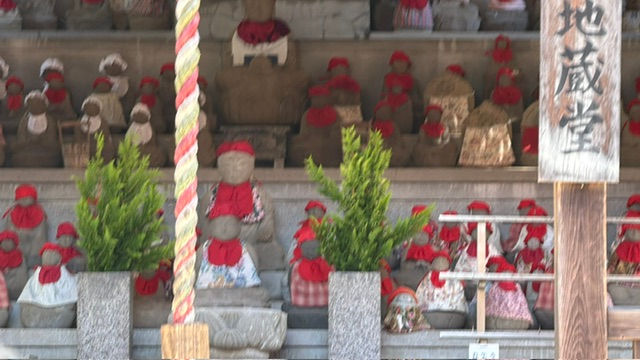
There are other shrines on the grounds of the compound, including one dedicated to the spirits of children who died in utero or during birth, or shortly after birth.
The entire visit was fascinating and entertaining. After ending the touring part of the visit, I headed back to the shopping area, caught up with Patrise, and we did some souvenir shopping. We returned to the bus by 12:15pm, well in advance of the stated 1:15 required return. Of course, some of our travel companions have taken the transportation deadlines as suggestions rather than directives. Fortunately for them, unfortunately for the rest of us, their tardiness has alwas been accommodated by the tour guides, meaning they suffered no ill effects of being late, so they have no incentive to change their way.
Once all were gathered who wanted to return on the bus, we left for the hotel. Upon disembarking at the hotel, Patrise and I returned to the restaurant that we tried to patronize yesterday: Wagyu Burgers and Dessert. Yesterday the store was out of burgers. Today, we had plenty of choices from which to choose. Patrise got the wagyu beef and avocado burger; I had the wagyu cheeseburger. They both consisted of two patties and a think, tasty hamburger bun. After finished our burgers, we picked up our pre-ordered ice cream – chocolate for her, matcha with pistachio for me.
We went back to the hotel room to rest a bit, watching a show on Netflix for an hour or so. Then we headed back outside about 4:30, to go to the shopping mall under the Kyoto train Station. Think “Mall of America” underground, but without the fancy rides. We walked around the mall (called Porta) for an hour, finally found some items we wanted to buy as souvenirs. We sauntered back to the hotel, stopping by the 7 Eleven across the street from the hotel, and then finally making it back to our room.
I worked on the blog while snacking. Patrise crashed early, which was to be expected, since she only slept for less than three hours last night.
Tomorrow we get a slightly later start on the day – 9:30am rather than the usual 9am – but we will be traveling all day, visting the Bamboo Forest, the Togetsukyo Bridge, the Golden Pavilion, and the Geisha Dstrict.


Comments